
Trickle charger for mobility scooter compatibility and choice
The charger’s voltage and battery chemistry matter more than the word “trickle”. A trickle charger for a mobility scooter must match the battery system, and the connector must fit the scooter. For example, a 3.5 A charger is designed for 24 V rechargeable lead-acid and gel battery systems, including batteries from 7 Ah to 22 Ah.
Choosing a charger can be confusing when specifications list voltage, current and connector types. Match these details to the battery and scooter rather than choosing by appearance or assuming one charger suits every model.
This guide explains how to check voltage and output, identify a compatible connector, and interpret charging indicators. It focuses on sealed lead-acid batteries, including AGM and gel types, so you can compare charger features and understand what affects charging time before choosing.
Key Takeaways
- Match the charger’s voltage, battery chemistry and connector to your scooter before choosing a model.
- Use battery capacity and charger amperage to judge whether the output suits your charging routine.
- Learn what charging indicators can tell you about charge progress and when charging has finished.
- Compare lead-acid charger types by their output, supported battery capacities and listed price.
- When replacing a battery, compare its voltage and amp-hour rating with the original to narrow down suitable options.
Charger compatibility with scooter makes and models
Yes, a trickle charger can charge mobility scooter batteries if its voltage and charging profile suit the battery chemistry. The plug must also fit the scooter’s charging socket. A low-current charger isn’t automatically suitable just because it connects physically. For example, a charger designed for another battery type may use the wrong charging profile.
Start with the scooter manual or the battery label. Record the battery voltage, chemistry and amp-hour capacity, then compare them with the charger’s specifications. Check the connector separately: mobility scooter chargers commonly use a round 3-pin connector, unless otherwise stated. A matching plug is useful, but it doesn’t prove electrical compatibility.
Neutrik 3-pin connections are described as compatible with 99% of scooter models. That broad figure still doesn’t replace checking the scooter’s voltage and charging requirements. Some chargers use a 3-pin XLR connection, so compare the connector type and pin arrangement with the scooter socket before connecting.
Amperage helps narrow the choice, but it doesn’t identify a compatible make or model on its own. A 2-amp, 24-volt charger is described as suitable for many smaller travel scooters. A 10-amp charger with a 3-pin XLR connection is intended for many larger mobility scooters. Match both figures to the battery system, not just the scooter’s size.
- 3-amp: Compare its voltage and charging profile with the battery specifications. The current rating alone doesn’t establish compatibility with a particular scooter.
- 5-amp: A listed 5-amp, 24-volt charger is described as suitable for batteries of 38 Ah and above.
- 7-amp: Check the charger’s stated battery range and scooter requirements. Don’t infer compatibility from the 7-amp output alone.
To connect a charger safely, switch off the scooter and use its designated charging socket. Check the plug alignment and insert it without forcing the pins, then connect the mains supply as directed in the charger instructions. Keep the charger and battery in a dry, ventilated location while charging.
For example, a scooter with a 24-volt lead-acid battery needs a charger specified for that system and battery chemistry. A 3-pin plug won’t make a charger designed for another voltage suitable. Disconnect the mains supply before removing the scooter connector, and stop if the plug, cable or battery shows damage.
Charger output amperage and voltage
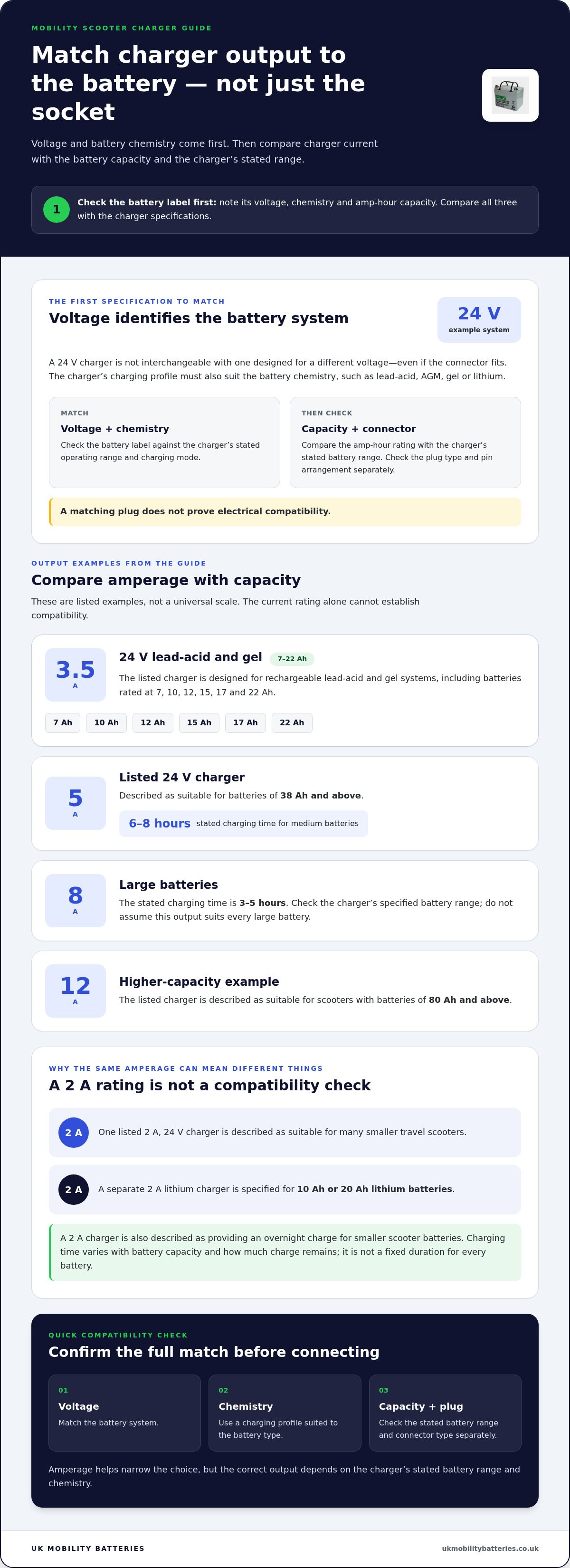
Voltage identifies the battery system; amperage describes the charger’s output current. Match the battery voltage first, then choose an output suited to its capacity and chemistry. A 24 V charger is not interchangeable with a charger designed for a different voltage, even if the connector fits.
Read the battery label and charger specifications before comparing models. Note the battery’s voltage, amp-hour rating and chemistry, such as lead-acid, AGM, gel or lithium. Compare these details with the charger’s stated operating range. The charger’s amp rating alone cannot establish compatibility.
For example, a listed 2 A, 24 V charger is described as suitable for many smaller travel scooters. A separate 2 A lithium charger is specified for 10 Ah or 20 Ah lithium batteries. These examples show why chemistry and voltage matter alongside current output. A 2 A rating does not make chargers suitable for every battery.
Charging time also depends on battery capacity and how much charge remains. A 2 A charger is described as providing an overnight charge for smaller scooter batteries. That is a practical charging pattern, not a fixed duration for every battery. A deeply discharged or higher-capacity battery takes a different time to charge.
- 3.5 A: The listed charger is designed for 24 V rechargeable lead-acid and gel battery systems. It suits batteries from 7 Ah to 22 Ah, including 7 Ah, 10 Ah, 12 Ah, 15 Ah, 17 Ah and 22 Ah capacities.
- 5 A: A listed 24 V charger is described as suitable for batteries of 38 Ah and above. Its stated charging time for medium batteries is 6-8 hours.
- 8 A: The stated charging time for large batteries is 3-5 hours. Check the charger’s specified battery range rather than assuming this output suits every large battery.
- 12 A: A listed charger is suitable for scooters with batteries of 80 Ah and above.
Use those figures as examples of matching output to capacity, not as a universal scale. The correct amperage depends on the charger’s stated battery range and chemistry. For instance, don’t choose a 5 A model for a smaller battery simply to shorten charging time.
Before connecting a battery charger, confirm that its output voltage and charging mode match the battery label. Keep lithium and lead-acid charging requirements distinct. If the scooter’s battery is worn or no longer holds charge, comparing sealed mobility battery options can help identify a replacement by voltage and amp-hour rating.
Automatic charging and status indicators
Automatic controls and indicators help you follow charging progress. Their meanings depend on the charger’s design and instructions.
Automatic charging behaviour
An automatic charger adjusts its operation as the battery charges. Intelligent charging is designed to help prevent overcharging and maintain battery health. This differs from a basic charger that may continue supplying current without the same automatic control.
Read the charger label and instructions to identify its charging mode. Confirm that its automatic profile suits the battery chemistry, whether lead-acid, AGM, gel or lithium. Don’t assume a charger intended for lead-acid batteries is suitable for lithium just because the voltage appears compatible.
Automatic operation doesn’t remove the need to choose the right charger. Match the battery voltage and chemistry, then follow the stated connection and charging procedure. Stop using the charger if its case, lead or plug is damaged.
Charging status indicators
Indicators show the charger’s operating state, but symbols and colours vary by model. One charger may use separate lights for charging and completion; another may have a changing display. Use the legend on the charger or its instructions to interpret each signal accurately.
Before charging, note the displayed status and compare it with the charger’s guide. A change during charging can show that the unit has moved to another stage. A completed-charge signal means the charger has reached its stated end point, not that it has diagnosed every battery fault.
If an indicator shows an error, flashes unexpectedly or remains unchanged, stop and consult the charger’s instructions. Check that the plug is seated correctly and the charging socket is clean. A status light cannot confirm that a battery retains its expected capacity.
Charger types and charging duration
A trickle charger supplies a low current to maintain charge, while a smart charger manages charging automatically. A standard mobility scooter charger follows its own design and may not provide the same maintenance function. These labels aren’t interchangeable, so compare the actual charging mode and battery compatibility.
Can you use a trickle charger with mobility scooter batteries? Yes, if its voltage, chemistry and charging mode match the battery. A charger isn’t suitable simply because it is described as low-current.
Can you leave a mobility scooter on charge overnight or long term? Overnight charging is appropriate only if the charger’s instructions allow it. Long-term connection requires a charger designed for continued maintenance charging; don’t assume every standard charger has this function.
Charging duration depends on battery capacity, remaining charge and charger output. A listed 2-amp charger is described as providing an overnight charge for smaller scooter batteries. Follow its indicator and instructions rather than using a fixed charging time for every battery.
Charger price
Treat this as the price of that charger, not a benchmark for every output, battery type or charging design. A lower price doesn’t establish that a charger suits your scooter, and a higher price alone doesn’t prove better compatibility.
Compare like with like before judging value. Start with the battery voltage and chemistry, then check the charger’s output current and stated battery range. Chargers for lithium and sealed lead-acid batteries may use different charging profiles. Compare their prices only if both meet your scooter’s requirements.
Next, check the practical details in each listing. A connector that fits the scooter, clear operating instructions and a stated charging mode help establish whether the product suits your needs. Don’t treat a familiar plug or higher amp rating as proof of compatibility. The specification must match the battery system.
- Voltage: Compare the charger’s output with the scooter battery’s voltage. A mismatch rules out a product, regardless of its price.
- Chemistry: Check whether the charger supports the battery type, such as lead-acid, AGM, gel or lithium.
- Current: Compare the amp rating with the battery capacity and the charger’s stated range.
- Connector: Confirm that the plug type matches the scooter’s charging socket and connection requirements.
That price does not mean every 2-amp charger costs the same, or that this model suits every scooter. Read the full specification beside the price, including voltage, battery chemistry and intended use. Compare the total product details, not a single headline figure.
Charging time can also affect value in practice. A lower-output charger may suit a routine that allows longer charging, while another setup may need a different output. Avoid paying for a specification your battery can’t use. Equally, don’t choose only by the lowest price if the charger’s stated range excludes your battery.
Use a simple sequence: identify the battery requirements, rule out incompatible chargers, then compare prices for the suitable models. If a listing lacks clear details about charging mode or battery type, it offers little basis for a sound comparison. Price matters only after compatibility is established.
Lead-acid mobility scooter chargers
For a sealed lead-acid mobility scooter battery, choose a charger designed for its chemistry and voltage. AGM and gel batteries are sealed lead-acid types, but the charger must still match the battery system and stated capacity. Listed scooter chargers use a three-stage charging design to manage the process.
Using the wrong charger with mobility scooter batteries can result in incorrect or incomplete charging. A mismatch in voltage, battery chemistry or charging profile can also affect battery performance and service life.
For example, a listed 3.5 A charger is designed for 24 V rechargeable lead-acid and gel battery systems. Its stated capacity range is 7 Ah-22 Ah, covering batteries rated at 7 Ah, 10 Ah, 12 Ah, 15 Ah, 17 Ah and 22 Ah. Check both the voltage and capacity range against the battery label.
Output current should suit the battery capacity. A listed 5 A, 24 V charger is described as suitable for batteries of 38 Ah and above, whilst a listed 12 A charger suits scooters with batteries of 80 Ah and above. These examples are not interchangeable: use the charger’s stated range rather than selecting by amperage alone.
Charging duration also varies with output and battery size. The stated charging time for medium batteries using a 5 A charger is 6-8 hours. For large batteries using an 8 A charger, the stated time is 3-5 hours. Treat these as model-specific examples, not fixed times for every lead-acid battery.
- Battery chemistry: Confirm that the charger supports sealed lead-acid, AGM or gel as applicable.
- Voltage: Match the charger to the battery system, such as a 24 V system.
- Capacity: Check the charger’s stated Ah range before connecting it.
- Connector and lead: Match the scooter socket and the charger lead arrangement.
Lead arrangements can differ too. A listed mains charger lead with a figure 8 connector is 2 metres long, while another listed mains charger lead for mobility scooters is 1.8 metres long. These details affect placement and reach, but they do not determine electrical compatibility.
Use this order when choosing: identify battery chemistry, match voltage, compare Ah capacity with the charger range, then check connector and lead. For a replacement sealed AGM battery, compare sealed AGM battery options by voltage and amp-hour rating.
With regular use and proper charging habits, sealed lead-acid mobility scooter batteries typically last 12 to 18 months, making those habits important for longevity.
UK Mobility Batteries: Lucas 12V 7Ah Sealed AGM Batteries
UK Mobility Batteries supplies Lucas 12V 7Ah Sealed AGM Batteries for mobility scooter battery replacement needs. Consider this option when your existing battery is a sealed AGM type and its voltage and amp-hour rating match. The battery label and scooter requirements remain the key compatibility checks.
Other options include the Lucas 12V 9Ah Uprated Sealed AGM Battery, Lucas 12V 34Ah Sealed AGM Deep Cycle Battery and Lucas 12V 20Ah Mobility Battery. Compare their stated voltage, capacity and battery type with your scooter’s original battery before choosing. A different capacity or battery type should not be assumed suitable simply because the battery fits the available space.
For a replacement sealed AGM battery, visit ukmobilitybatteries.co.uk to view the available options, or contact UK Mobility Batteries for assistance.
Choose your next step with confidence
Before choosing a trickle charger for a mobility scooter, use the battery label and scooter manual as your references. If the battery no longer performs as expected, consider whether replacement, rather than a different charging routine, is the more relevant next step. Keeping the decisions separate helps you focus on the equipment issue you need to resolve.
UK Mobility Batteries offers Lucas 12V 7Ah Sealed AGM Batteries, the Lucas 12V 9Ah Uprated Sealed AGM Battery and the Lucas 12V 34Ah Sealed AGM Deep Cycle Battery. Compare the battery type and stated capacity with your scooter’s existing battery requirements before selecting a replacement. These options provide a starting point for considering a sealed AGM battery suited to your scooter’s needs.
For help exploring the available battery options, contact UK Mobility Batteries. A clear next step can make choosing the right equipment simpler.
Frequently Asked Questions
How do I know which charger I need?
Use the battery label and scooter manual to identify the required voltage, chemistry and capacity. Match these details with the charger’s stated output and battery range. For example, a lead-acid battery needs a charger with a suitable lead-acid profile. Check the connector too, but don’t treat a matching plug as proof that the charger is electrically suitable.
How do I look after my battery to make it last longer?
Use a compatible charger and avoid letting the battery run completely flat. After a journey, follow the charging routine in the scooter and battery instructions rather than leaving a discharged battery unused. Keep the charging area dry and ventilated, and check the case, leads and connectors for damage before charging. Stop using damaged charging equipment.
What is a trickle charger for a mobility scooter?
A trickle charger supplies a low current to maintain a battery’s charge. It suits a scooter battery only when its voltage, chemistry and charging mode are compatible. It differs from a smart charger, which controls charging automatically, and from a standard charger with a different process. Check the instructions to see whether the charger supports maintenance charging.
What voltage and charger type does my mobility scooter need?
The battery label or scooter manual identifies the required voltage and chemistry. Match the charger to both, such as a charger designed for a 24 V lead-acid or gel system. An AGM battery is also lead-acid, but the charger must support its charging requirements. Don’t choose by connector shape alone, since a physically fitting plug cannot correct a voltage or chemistry mismatch.
How much do mobility scooter trickle chargers cost in the UK?
This is one listing, not a general price for every trickle charger or charger type. Before comparing prices, narrow the options to models that match your battery’s voltage, chemistry and capacity. A lower price is no use if the charger’s specification doesn’t suit your scooter.
How often should mobility scooter batteries be charged when not in use?
Charge the battery according to the scooter and battery instructions, and don’t let it run completely flat during storage. The right routine depends on the battery and whether the charger is designed for maintenance charging. If the charger supports long-term connection, follow its guidance; otherwise, use the battery instructions to determine when to recharge during periods without regular use.