
How to match batteries in a 24v set before expanding the bank
A 24V bank needs batteries with matching voltage, capacity rating, chemistry and batch. For matching batteries in a 24V set, pair two compatible 12V batteries in series; the pack voltage becomes 24V, whilst its amp-hour capacity stays the same as one battery. Mixing batteries of different ages, capacities or chemistries can cause charging problems and shorten battery life.
Adding another battery may seem like a straightforward way to increase a bank’s capacity, but the result depends on how the batteries are connected and whether their battery management systems (BMS) are compatible. A mismatch can affect charging and performance.
This guide explains what to match before expanding a 24V bank, how series wiring differs from parallel strings, and why BMS compatibility matters. You’ll also learn how to assess capacity and connection layout before adding batteries, so you can make a practical decision based on the existing bank rather than voltage alone.
Key Takeaways
- Compare each battery’s BMS limits and confirm the manufacturer permits the intended series connection before wiring.
- For parallel strings, connect the load across opposite ends of the bank to help keep the batteries equalised.
- Plan the connection carefully: bringing the remaining positive and negative terminals together can cause a short circuit.
- Before adding capacity, assess whether a parallel arrangement suits the bank and how its wiring will share the load.
Battery management systems and series-connected batteries
In the UK, first identify the requirements for the equipment and installation setting, then follow the relevant instructions and standards. Fixed installations, vehicles and mobility devices may have different requirements.
- Confirm that both batteries’ manufacturers permit series connection. Two compatible 12V batteries form a nominal 24V bank; two 12V, 35Ah batteries produce a 24V, 35Ah pack. The voltage adds, but the amp-hour rating remains unchanged. Check the battery labels and documentation before planning the connection.
- Check whether each battery’s battery management system (BMS) supports series operation. A BMS monitors and protects its battery, but not every model is suitable for a series string. Confirm the permitted configuration and operating limits in the manufacturer’s instructions. If either BMS does not support the arrangement, do not connect the batteries in series.
- Connect one battery’s positive terminal to the other battery’s negative terminal to create the series link. The bank’s output comes from the two unused terminals: the first battery’s negative and the second battery’s positive. Check the polarity against the system diagram before connecting a load or charger. Keep exposed terminals away from each other and from conductive objects.
- Plan and inspect the cable connections before energising the bank. Follow the battery and equipment instructions for connection methods and cable requirements, as an unsuitable cable can compromise operation. With the bank isolated, check that the terminal connections are secure and the polarity is correct. Never connect the remaining open positive and negative terminals to each other: this can cause a short circuit, damage or injury.
UK requirements depend on whether the bank is in a fixed installation, vehicle or mobility device. Identify the requirements for that equipment and setting, and follow the relevant instructions and standards.
Expanding a battery bank with parallel strings
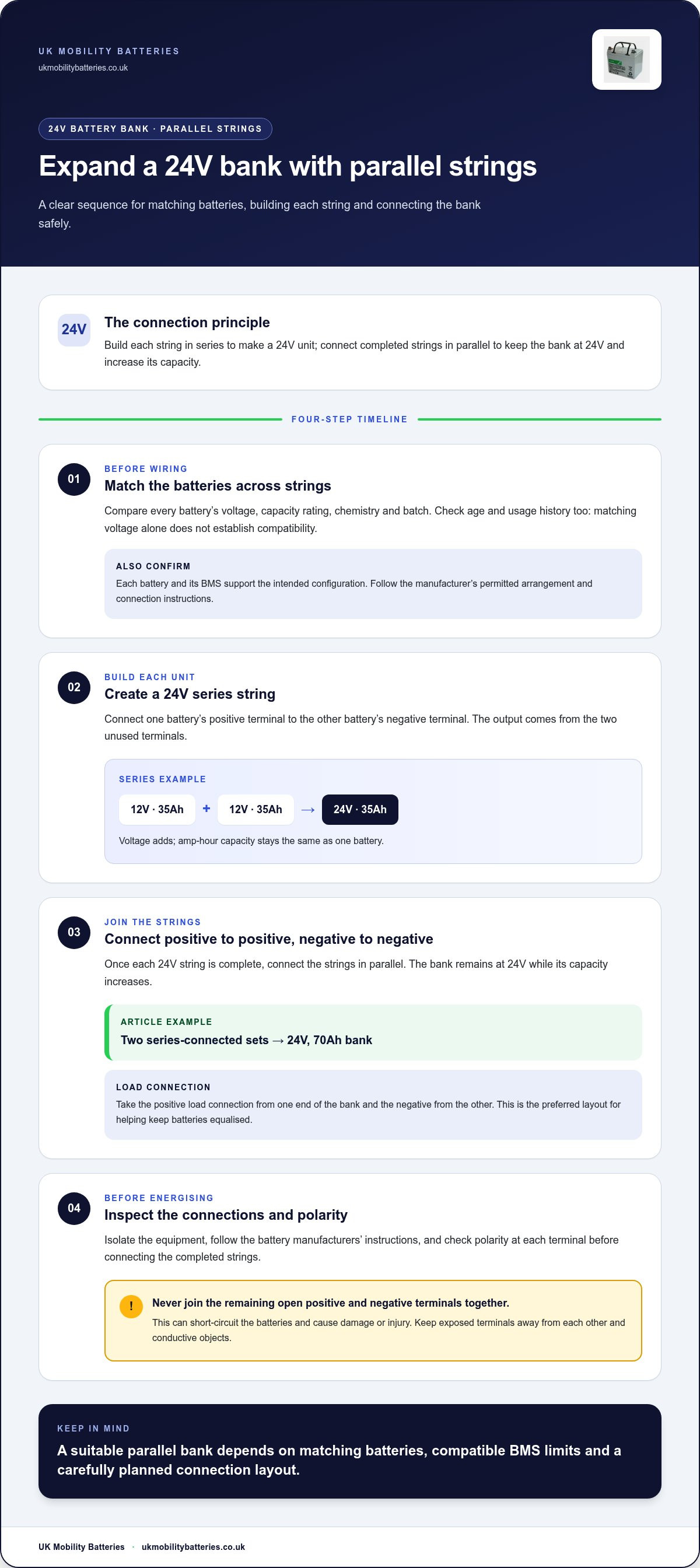
Plan each string as a complete unit before joining strings in parallel. In the example below, two series-connected sets form a 24V, 70Ah bank.
-
Match batteries across parallel strings
Use batteries with the same voltage, capacity rating, chemistry and batch in each 24V string. Matching capacity across strings is advisable, such as using equal-capacity batteries throughout the bank. This helps avoid combining unlike batteries in one parallel arrangement. Check that each battery and its management system supports the intended configuration, and don’t assume that matching voltage alone makes batteries compatible.
-
Plan series-parallel connections
Draw the complete arrangement before connecting any cables. First wire compatible batteries in series to create each 24V string; then connect the strings in parallel to keep the bank at 24V and increase its capacity. For example, two series sets can be connected in parallel to form a 24V, 70Ah pack. Label each string’s positive and negative output clearly on the diagram.
-
Connect batteries safely
Isolate the equipment and follow the battery manufacturers’ connection instructions. Check polarity at each terminal, then connect the completed strings in parallel, positive to positive and negative to negative. For a parallel bank, take the positive load connection from one end and the negative from the other; this is the preferred layout for keeping batteries equalised. Never join a pack’s remaining open positive and negative terminals together, as this can short-circuit batteries and cause damage or injury. Two 24V 100Ah batteries can provide 200A when each has a 100A BMS, provided the battery configuration permits it.
Matching batteries by voltage, capacity, chemistry, age and batch
Before expanding a 24V bank, compare every battery’s voltage, amp-hour capacity, chemistry, age and batch. Mismatches can cause charging problems and shorten battery life, so treat compatibility as a complete specification check.
-
Compare battery specifications
Record the voltage, capacity rating and chemistry shown on each battery. Match these specifications across batteries intended for the same bank, and avoid combining different chemistries. Parallel wiring increases capacity while keeping voltage unchanged, so a capacity mismatch affects how the bank operates. A 24V bank should have comparable capacities across parallel strings for balanced performance.
Also compare the battery management system requirements. A LiFePO4 battery’s BMS and manufacturer’s connection limits matter when you add it to an existing bank. Don’t assume that two batteries with the same voltage will be compatible.
-
Check battery age and batch
Compare the batteries’ batch details and service age before pairing them. Batteries from different batches or with different usage histories may perform differently, even when their labels show the same voltage and capacity. A mismatched set can develop charging problems, and the less suitable battery may limit the bank’s performance.
When expanding a bank, record the existing batteries’ details and compare them with the proposed additions. Consider age, batch, chemistry and capacity together: matching just one specification does not establish compatibility.
-
Assess capacity mixing risks
Prioritise matching capacity when adding batteries in parallel. A 24V 100Ah LiFePO4 battery can be added to a 24V bank with a different capacity, but compatibility still depends on the manufacturer’s permitted arrangement and BMS. Capacity matching remains advisable; don’t treat the example as a universal rule for every battery.
Mismatched batteries can cause charging problems and shorten battery life. For van planning, 2,400 watt hours may suit a modest conversion, whilst an original camper-van proposal targeted 4,800 watt hours. Use those examples to frame energy needs, then calculate demand from the appliances and expected use in your own setup.
Series wiring and voltage
- Calculate the pack voltage before selecting a series layout. Two 12-volt batteries connected in series make a nominal 24-volt pack. Three 12-volt batteries make 36 volts, whilst four make 48 volts. Check that the equipment is designed for the resulting voltage before adding batteries.
- Keep the amp-hour rating in view. Two 12-volt batteries rated at 35 amp-hours produce a 24-volt pack rated at 35 amp-hours. Series wiring adds voltage, not amp-hour capacity. The process of matching batteries in a 24v set starts with choosing compatible batteries with the capacity required by the system.
- Read the manufacturers’ instructions before connecting a series pair. Confirm that each model permits series connection and that its voltage suits the charger and load. A battery’s nominal voltage alone doesn’t establish compatibility with the equipment. For example, select a charger designed for the complete 24-volt bank, not simply one matching an individual battery’s label.
- Compare the appliance’s current demand at its operating voltage. A 1500-watt electric heater running from a 24-volt battery is estimated to draw half the current it would draw at 12 volts. This illustrates how voltage affects current demand, but it doesn’t increase the bank’s amp-hour rating or establish whether a battery can supply the load. Check the equipment requirements.
- Record the intended voltage, battery count, capacity and equipment requirements before connecting anything. Check the layout against the battery and equipment instructions, including the charger’s voltage. For matching batteries in a 24v set, this record helps identify whether a proposed change affects voltage, capacity or both. If you’re selecting 12-volt batteries for a compatible setup, compare 12-volt battery options.
UK Mobility Batteries: Lucas 12V 7Ah Sealed AGM Batteries
UK Mobility Batteries supplies the Lucas 12V 7Ah Sealed AGM Batteries for readers considering a 12V battery for a mobility scooter or wheelchair. If your equipment uses a 24V bank, two batteries in series must meet the same compatibility requirements, including matching voltage, capacity and chemistry, and manufacturer approval for series connection. Don’t treat a single 12V battery as a complete 24V set.
Compare the 7Ah option with the Lucas 12V 9Ah Uprated Sealed AGM Battery, Lucas 12V 34Ah Sealed AGM Deep Cycle Battery and Lucas 12V 20Ah Mobility Battery against your equipment’s requirements. Choose batteries by their specifications and intended use, not capacity alone. Visit ukmobilitybatteries.co.uk to explore the battery options.
Make the next expansion easier to assess
Before changing a bank, keep a simple record of its battery labels, wiring layout and equipment requirements. This gives you a clear reference when planning matching batteries in a 24V set, and helps distinguish a capacity change from a change in voltage or chemistry. It also makes later replacements easier to assess against the existing configuration.
Write down the intended arrangement before buying or connecting batteries. Include the charger and load requirements, then compare them with the battery specifications and the manufacturer’s connection instructions. If the proposed setup differs from the current one, resolve compatibility before installation rather than relying on voltage alone.
For help choosing a suitable battery for your mobility equipment, contact UK Mobility Batteries. A clear record of the existing battery and equipment requirements will make your next step more focused.
Frequently Asked Questions
How do you match batteries in a 24V battery bank?
Record each battery’s model, chemistry, capacity, age and BMS details. Compare them with the charger and equipment requirements, then plan the bank configuration. For example, label each battery and mark its position on the wiring diagram before installation. This makes it easier to spot a replacement with different specifications before adding it to the bank.
Should batteries connected in series have the same voltage, capacity and chemistry?
Yes. For a series set, choose batteries with the same nominal voltage, capacity rating and chemistry, and confirm that the manufacturers allow this configuration. The same current passes through every battery in a series string, so a weaker or unsuitable unit can limit the set’s performance. Check charging requirements too: a charger profile suited to one chemistry may not suit another.
Can you connect batteries of different ages or brands in a 24V set?
Avoid pairing batteries of different ages. Brand alone does not determine compatibility, but different models may have different capacities, charging behaviour or BMS limits. Compare their full specifications rather than relying on matching labels or appearance. When replacing a battery in an existing set, assess whether the remaining battery’s specifications and condition suit the proposed replacement arrangement.
What voltage and state-of-charge differences are acceptable between batteries before connection?
There is no single voltage or state-of-charge difference that applies to every chemistry and BMS. Follow the manufacturer’s matching instructions for the specific battery models. Before connecting batteries, use a charger suited to their chemistry to bring them to a comparable state of charge. A voltage reading alone may not indicate an equivalent charge level across different chemistries.
How do you test and balance batteries in a 24V bank?
With the bank isolated, measure each battery individually with a suitable meter, and record readings under comparable conditions. Compare the results with the battery specifications and identify any unit that differs markedly from the others. Use a charger designed for the battery chemistry and follow its balancing instructions. Do not try to correct an imbalance by connecting terminals directly.