
2 ways to assess a 34Ah to 50Ah mobility scooter upgrade
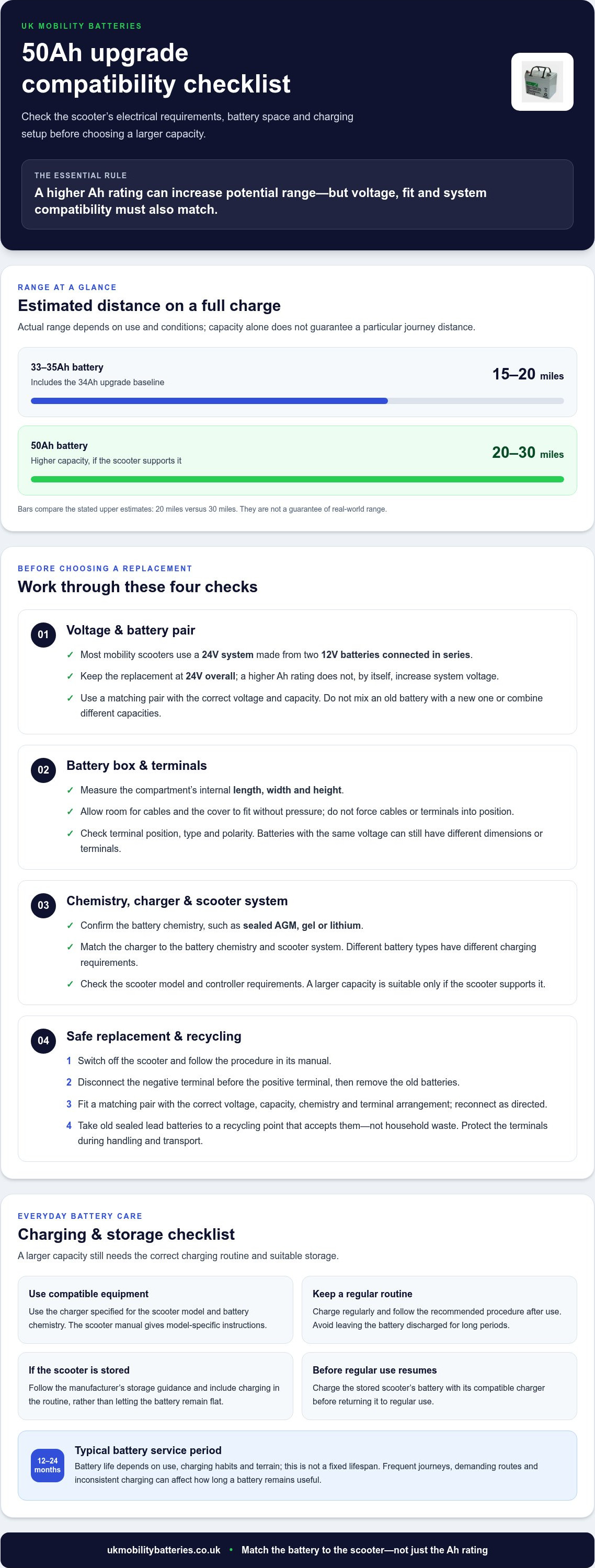
A 50Ah mobility scooter battery is estimated to provide 20–30 miles on a full charge, compared with 15–20 miles for a 33–35Ah battery. For anyone considering upgrading a mobility scooter from 34Ah to 50Ah, the voltage must stay the same and the larger batteries must fit the scooter’s battery box and work with its controller. Capacity can increase potential range, but it isn’t the only compatibility factor.
Most mobility scooters use a 24V system made up of two 12V batteries. Battery types include sealed AGM, gel and lithium, so understanding the chemistry and charger requirements matters as much as comparing amp-hour ratings.
This guide explains the two key ways to assess an upgrade: whether the scooter can accommodate 50Ah batteries, and whether the expected range suits your journeys. It also covers battery types, charging time, charger compatibility, and the everyday charging and storage practices that support battery care.
Key Takeaways
- Compare the replacement battery’s voltage, chemistry and dimensions with your scooter’s requirements before choosing a higher capacity.
- Consider the battery box and controller as well as the amp-hour rating, since physical fit and system compatibility both affect an upgrade.
- Find out how your charger’s specifications relate to a larger battery, as charging time depends on the charger and battery capacity.
- Keep batteries regularly charged and avoid leaving them discharged for long periods to support battery care.
- Assess battery weight alongside range, handling and the scooter’s load requirements before deciding whether a 50Ah setup suits your use.
1. Can you upgrade your scooter battery for Greater Range?
Yes, upgrading a mobility scooter from 34Ah to 50Ah can increase its potential range, provided the scooter supports the larger battery. Capacity is only one part of the match. The replacement must also suit the scooter’s voltage, battery box, terminals and charging system. A 50Ah battery that cannot be installed correctly is not a suitable upgrade.
Most mobility scooters use a 24V system made from two 12V batteries connected in series. That arrangement combines their voltage to supply the scooter. Keep the replacement voltage at 24V overall. For a 34Ah to 50Ah change, both batteries should be a matching pair with the correct voltage and capacity. Don’t mix an old battery with a new one, or combine different capacities in the same system.
Compare the existing battery label and compartment with the proposed replacement. Measure the battery box’s internal length, width and height, then allow room for the cables and cover to fit without pressure. Check terminal position, type and polarity too. Two batteries can share a 12V rating yet have different dimensions or terminals. Confirm the battery chemistry, such as sealed AGM or gel, and charger compatibility before selecting a replacement. The controller and scooter model also affect whether a higher capacity is supported.
What is the UK price of compatible 50Ah mobility scooter batteries? There isn’t one price for every compatible 50Ah battery. The product type and scooter requirements determine which replacement is suitable, so capacity alone doesn’t establish the price.
Can a larger-capacity battery damage the scooter controller, wiring or motor? A higher Ah rating does not, by itself, increase system voltage. Damage can result from using the wrong voltage or incompatible charging equipment. Correct fit, secure connections and polarity also matter.
How to replace mobility scooter batteries safely and correctly: Switch off the scooter and follow the replacement procedure in its manual. Disconnect the negative terminal before the positive terminal, then remove the old batteries. Fit a matching pair with the correct voltage, capacity, chemistry and terminal arrangement, and reconnect them as directed. Do not force cables or terminals into position.
How should old mobility scooter batteries be recycled in the UK? Take old sealed lead batteries to a recycling point that accepts them, rather than putting them in household waste. Protect the terminals during handling and transport.
For upgrading mobility scooter batteries, use the scooter model, battery-box measurements and electrical requirements together, not the Ah figure alone. A larger battery can support longer journeys only when it fits and works with the scooter’s system. If any of these details differ from the existing setup, the proposed replacement may not be compatible.
2. Charging and storage practices
Regular charging and suitable storage support mobility scooter battery care. Batteries typically last between 12 and 24 months, depending on use, charging habits and terrain. That period is not a fixed lifespan: frequent journeys, demanding routes and inconsistent charging can affect how long a battery remains useful. A larger-capacity replacement still needs the charging routine specified for its battery type and scooter model.
Charge the battery regularly, and do not leave it discharged for long periods. Follow the instructions for your scooter and charger, including the recommended charging procedure after use. If the scooter is parked for an extended period, include charging in its storage routine rather than letting the battery remain flat. This applies to sealed lead-acid and lithium batteries, but each requires compatible charging equipment.
Use these practical steps to organise charging and storage:
- Use the charger specified for the scooter model and battery chemistry.
- Choose a consistent charging routine that prevents long periods in a discharged state.
- Keep the scooter and battery in a suitable storage position, following the manufacturer’s instructions.
- Before returning a stored scooter to regular use, charge the battery using its compatible charger.
Battery chemistry matters. Sealed lead-acid batteries, including AGM, and lithium batteries have different charging requirements. A lightweight lithium replacement may have different specifications from the original battery. Using the wrong charger can cause problems, so match the charger to the battery chemistry and scooter system. The scooter manual provides model-specific charging and storage instructions.
Storage habits affect how ready the scooter is for its next journey. If it will not be used for a while, avoid leaving the battery discharged. Follow the manufacturer’s storage guidance for your scooter model and maintain the battery accordingly. A larger capacity does not remove the need for regular charging: capacity changes the amount of stored energy, not the need for appropriate care.
Charging practice can help extend useful battery life, but it cannot compensate for an incompatible charger or unsuitable storage conditions. If a battery repeatedly loses charge or the scooter behaves differently after storage, use the model’s manual to review the charging procedure and battery requirements. A gradual decline over the typical 12 to 24 months of service also provides a reason to assess battery condition and replacement needs.
When comparing a replacement, keep the chemistry and charging instructions in view alongside capacity. The mobility scooter battery range can help you compare battery types for your scooter.
3. Is the scooter charger compatible with 50Ah batteries, or will charging take longer?
A charger’s compatibility depends on its output voltage, charging profile and battery chemistry, not capacity alone. For a 24V scooter system, the charger must suit that system and the replacement battery type. Check the charger label and scooter manual before connecting a larger-capacity battery. Using the wrong voltage or incompatible charging equipment can damage the scooter.
Charging generally takes longer with a 50Ah battery than a 34Ah battery when using the same charger. The charger supplies current over time, and the larger capacity needs more charge to reach full capacity. Actual charging time also depends on the battery’s starting charge and the charger’s charging profile. The available facts don’t support one fixed number of hours for every scooter and charger combination.
A 24V 8A mobility scooter charger is advertised for batteries rated from 50Ah to 80Ah. This gives a useful example of a charger specified for batteries in that capacity range. It doesn’t establish compatibility with every scooter model. The connector, voltage and battery chemistry still need to match the scooter’s system.
- Read the charger’s output voltage and current rating from its label.
- Compare those details with the scooter manual and replacement battery requirements.
- Confirm that the charger suits the battery chemistry, such as AGM, gel or lithium.
- Use the scooter’s charging instructions rather than relying on capacity alone.
Battery chemistry matters because sealed lead-acid and lithium batteries have different charging requirements. An AGM battery is not automatically interchangeable with a lithium battery just because both fit the battery box. A charger designed for one chemistry may not charge another correctly. Keep using the existing charger only if its specifications match the replacement battery and scooter.
For a 34Ah-to-50Ah change, assess the complete 24V setup, not just one battery. Most mobility scooters use two 12V batteries connected in series. Both batteries should be replaced together as a matched pair, and the charger must suit that pair’s chemistry and capacity. A single 12V charger isn’t the same as a charger designed for the full 24V system.
Once compatibility is established, follow the scooter manufacturer’s charging procedure. Don’t leave batteries discharged for long periods, and use the correct charger after journeys. A higher-capacity battery can increase the energy available for use, but charging still depends on the charger’s output and the battery’s condition. That distinction helps explain why a 50Ah upgrade may take longer to charge without implying a universal charging time.
4. How much extra range does a 50Ah battery provide compared with a 34Ah battery?
A 50Ah mobility scooter battery is estimated to provide 20–30 miles on a full charge. A 33–35Ah battery is estimated to provide 15–20 miles. Since 34Ah falls within that second capacity band, these figures suggest more potential range with 50Ah. They don’t establish an exact increase for every scooter or journey.
The capacity difference is 16Ah per battery, but miles don’t rise in a fixed proportion to amp-hours. A 50Ah battery doesn’t automatically deliver a particular number of extra miles. The published estimates span several miles for each capacity, reflecting that battery capacity is only one part of the scooter’s energy use.
Route conditions help explain the variation. A scooter travelling over uneven ground or uphill uses energy differently from one following a flat route. Passenger load, speed, frequent stops and the scooter’s condition also affect distance per charge. Consequently, two scooters with the same 50Ah battery can achieve different ranges.
To judge whether an upgrade will suit your journeys, make a practical comparison:
- Record how far your scooter currently travels on a full charge, using familiar routes.
- Note whether hills, rough surfaces, stops or heavier loads affect those journeys.
- Compare your current experience with the estimated 20–30-mile range for 50Ah batteries.
- Consider whether the added capacity addresses a regular journey need or simply increases unused reserve.
Keep the estimates in context. The 15–20-mile figure applies to the 33–35Ah capacity group, not specifically to every 34Ah scooter. Likewise, 20–30 miles is an estimate for a 50Ah battery, not a guaranteed distance. Your scooter’s drive system and the conditions of use influence the result.
Battery condition matters too. A worn battery may deliver less useful range than a replacement with the same capacity. Charging habits, terrain and use affect battery life, so an upgrade will not solve every cause of reduced distance. If range has fallen, consider whether the battery is ageing or your scooter use has changed before attributing the difference to Ah alone.
For a sound comparison, separate the capacity estimate from the scooter’s compatibility requirements. The battery must suit the scooter’s voltage and physical layout, and both batteries in a paired system should match. A 50Ah replacement is most relevant when the scooter supports it and the additional estimated range aligns with actual travel needs. Plan around the routes you use, not the top end of an estimate.
5. Will heavier 50Ah batteries affect scooter performance, handling or weight limits
A 50Ah battery may weigh more than a 34Ah battery, but capacity alone doesn’t establish its weight. Battery chemistry and model affect mass, so compare the actual replacement’s weight with the existing batteries. The combined weight matters too, particularly where the scooter’s battery compartment has limited space or its load limit is already close.
Battery weight can affect how the scooter handles when turning, starting and stopping. Added weight changes the load carried, and its position matters because batteries sit in a compartment designed for the model. A replacement must fit securely in that space. Do not alter the battery layout or force a larger battery into the compartment.
Check the scooter’s permitted load in its manual, then account for the rider and anything carried. Include the combined weight of both replacement batteries when considering the total load. An upgrade does not increase the scooter’s permitted load. Any change to the available margin matters for everyday use, even if the scooter still moves.
Weight can also influence performance because the motor moves the scooter and its total load. A heavier setup may affect acceleration, braking response and energy use, particularly on slopes or uneven routes. The effects depend on the scooter model, battery arrangement and load. Do not assume that added capacity improves every aspect of performance.
Chemistry can change the weight comparison substantially. Lithium mobility scooter batteries can be up to 7 times lighter than typical batteries. That figure describes lithium batteries against typical batteries, not a guaranteed comparison between two specific 34Ah and 50Ah products. Compare each battery’s listed weight and chemistry rather than using capacity as a proxy.
Before choosing a 50Ah replacement, work through these checks:
- Compare the weight of both proposed batteries with the existing pair.
- Check that the battery box supports their dimensions and keeps them secure.
- Review the scooter manual for its load limit and battery requirements.
- Consider how the rider, carried items and battery weight combine during use.
These checks help distinguish a range upgrade from a suitable overall setup. A 50Ah battery may offer greater potential range, but weight, fit and load still need to work for the scooter. If the battery chemistry changes, compare its weight directly; lithium can be up to 7 times lighter than typical batteries, while individual products vary. Compare mobility scooter battery options with the scooter’s requirements in mind.
UK Mobility Batteries: Lucas 12V 7Ah Sealed AGM Batteries
UK Mobility Batteries supplies Lucas 12V 34Ah Sealed AGM Deep Cycle Batteries and Lucas 12V 20Ah Mobility Batteries for scooter replacements. If you’re assessing an upgrade, compare each battery’s capacity and type with your scooter’s requirements. Voltage, battery-box dimensions, terminal layout and charger compatibility all matter. Capacity alone doesn’t determine whether a replacement suits your scooter.
The Lucas 12V 7Ah Sealed AGM Batteries and Lucas 12V 9Ah Uprated Sealed AGM Battery are options for scooters designed for those specifications. UK Mobility Batteries also provides expert technical support to help with battery selection. For product details or assistance choosing a suitable replacement, visit UK Mobility Batteries.
Make your next battery choice with a clear plan
Before upgrading a mobility scooter from 34Ah to 50Ah, turn the decision into a practical specification for your next battery purchase. Note your scooter model, the battery type currently fitted and the journeys you want your setup to support. That gives you a clear basis for comparing suitable options rather than choosing by capacity alone.
If a 50Ah configuration isn’t the right match, selecting a replacement that suits your scooter remains a useful next step. UK Mobility Batteries offers Lucas 12V 34Ah Sealed AGM Deep Cycle Batteries, alongside Lucas 12V 9Ah Uprated Sealed AGM Batteries and Lucas 12V 7Ah Sealed AGM Batteries. The right choice depends on your scooter’s requirements, not simply the largest capacity available.
For help with your battery selection, contact UK Mobility Batteries for advice. A clear specification helps you move towards a replacement decision with confidence.
Frequently Asked Questions
What battery should you use?
Choose the chemistry, voltage and physical format specified for your scooter, rather than relying on amp-hour capacity alone. Mobility scooter batteries may be sealed AGM, gel or lithium, and their charging requirements differ. For example, if your manual specifies AGM, choose a compatible AGM replacement rather than substituting lithium based only on capacity. Check the battery label and manual together before ordering.
Can you upgrade your scooter battery for greater range?
A compatible higher-capacity battery can extend potential range, but the useful gain depends on the scooter and journey. A short, flat trip may not need the extra reserve, while hills, frequent stops and heavier loads can use more energy. Treat range estimates as planning guides, and consider your usual route and the battery’s condition rather than assuming a fixed increase in distance.
Can I upgrade a mobility scooter from 34Ah to 50Ah batteries?
Yes, upgrading a mobility scooter from 34Ah to 50Ah is possible when its model supports the larger capacity. Keep the system voltage and battery chemistry suitable, and ensure both batteries in the 24V pair match. The 50Ah units must fit securely, and the charger must suit the battery chemistry and system. Capacity alone cannot establish compatibility, so compare the scooter manual with the battery specifications.
What battery voltage, dimensions and terminal type does my mobility scooter need?
Use the scooter manual and existing battery label to identify the required voltage, dimensions and terminal arrangement. Most mobility scooters use a 24V system made from two 12V batteries, but the physical details vary by model. Measure the battery space and note how the existing cables connect. Match the replacement’s terminals and polarity to the scooter, rather than relying on its voltage or capacity alone.
Will 50Ah batteries fit in the scooter’s battery compartment?
A replacement will fit only if its dimensions suit the compartment and leave the cables and cover unobstructed. Compare its length, width and height with the available internal space, including any dividers or retaining straps. Check the terminal position too: a battery may fit physically but still prevent correct cable routing. Never force a larger battery into the compartment or leave it unsecured.